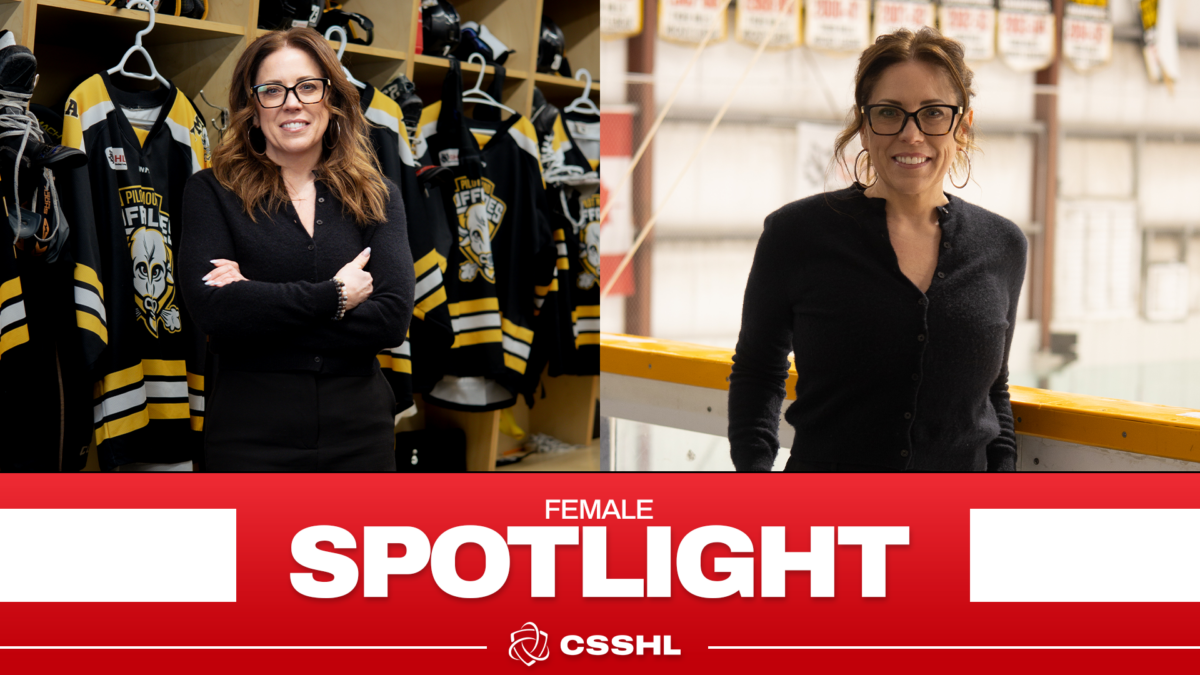
In Pilot Mound, Manitoba, hockey is more than a sport. It is part of the fabric of the community, woven into family, business, education and the very identity of a small town. For Nichole Collins, that connection runs even deeper.
Collins is the General Manager of the family-owned Pilot Mound Hockey Academy and the first female General Manager in the Canadian Sport School Hockey League (CSSHL). But her story isn’t simply about breaking a barrier in hockey management, it is about returning to the community that raised her, carrying forward a family philosophy of community sustainability, and using hockey as a vehicle to help young people build lives well beyond the rink.
“I’m just one face of a larger family and organization,” Collins says.
That humility is characteristic of someone who was raised in a family where everyone had a role to play. Collins grew up in a very large family in a very small town. She and her cousins were raised in the same community by their grandparents and 16 aunts and uncles. There were 26 grandchildren and, eventually, 46 great-grandchildren.
Her grandparents owned several businesses, but the purpose wasn’t simply to build legacy. The family believed businesses should strengthen the community around them, with money generated locally being reinvested to help keep the town alive.
That philosophy would eventually become the foundation for Pilot Mound Hockey Academy.
About 15 years ago, the family began to recognize signs that their community was struggling. The rink was being used only about half the time. School enrolment was declining. At the same time, the family had a deep connection to hockey.
Collins recalls that the girls in the family were often playing at a higher level than the boys. An uncle had coached hockey, including at established hockey academies, and the family began exploring whether a hockey academy could become part of the solution for their community.
They decided to build their own. The vision was ambitious but straightforward: create a hockey academy that combined elite development with the advantages of small-town life.
Inspired by the dorm-style models used by programs such as Notre Dame and Shattuck-St. Mary’s, the family wanted to create an environment where young athletes could focus on hockey without losing the community atmosphere that had shaped their own lives.
They started with one U17 Prep team before adding a women’s U18 Prep team. The program has since added a U15, U15 Prep, U17 and U18 Prep team.
What began with billeting has evolved into a comprehensive residential operation. The academy added ATCO trailers before eventually constructing its own dormitory facility. Three years ago, the first phase of that facility opened, and the organization is now working through another expansion.
The ultimate goal is to house all six teams in a facility that includes dorm rooms, dining areas, recreation spaces, a gym, laundry facilities, classrooms and boardrooms.
Everything is designed around the same philosophy: give student-athletes everything they need within walking distance. The arena is in the same general area. The school is only a block or two away. It is hockey development, education and community living wrapped into one experience.
For Collins, that is what makes Pilot Mound unique. And it is also why her own journey has come full circle.
Collins started playing hockey when she was three years old. For much of her childhood, she didn’t even consider the possibility that there were other sports. “Hockey and then baseball in the spring,” she said.
In a small-town playing sports were about more than individual ambition. Everyone participated because teams needed players. Collins played minor hockey with the boys because she was one of only a couple of girls in the community. Her cousin Delaney was the other.
Eventually, Collins began playing up with her brother’s team, who was two years older than her. She did it every season until the physical gap became too significant. By U13, she was getting hit by players who were simply bigger and stronger. That was when the family began looking for a women’s program.
Collins moved to Westman and began her AAA career, playing there from ages 13 through 18. The team played together for five years, with many of the same players and the same coach. They developed chemistry that came from years of playing alongside one another, and the results followed.
There were provincial championships, Western Canadian appearances and countless hours on the road. For Collins, it was also a lesson in commitment. Westman was roughly an hour and a half away from home, meaning practices could require a three-hour round trip several times a week, followed by games on weekends.
In Grade 11, the University of Manitoba came calling. Collins began playing with the Bisons through grade 11 and 12 and through university, where she continued to excel academically. She eventually earned All-Canadian Academic recognition and a place on the Dean’s Honour List.
Collins entered university intending to become a lawyer. She earned a degree and attended graduate school in criminology and planned to attend law school. Then life intervened and her daughter was born, and the path changed.
Instead of law school, Collins built a career in oil and gas, human resources and post-secondary education. Along the way, she developed extensive experience in leadership, business management, organizational effectiveness and human resources.
Those skills would eventually become invaluable when she returned to Pilot Mound.
As the academy continued to grow, the family members who had initially built it began to feel the weight of managing an increasingly complex organization. They asked Collins to come home where her role was to help with sustainability, expansion and the overall business strategy of the academy.
She arrived with a clear objective: rebuild and strengthen the organization following the challenges of the COVID-19 pandemic.
The pandemic created significant challenges for the academy and hockey academies more broadly. Collins helped lead the rebuilding process after Pilot Mound shifted from a U17 Varsity team to U17 Prep.
Now, the focus has shifted again as Pilot Mound continues to grow, expand and fine-tune.
It is a role perfectly suited to someone who describes herself as a builder and a big thinker. Sometimes, she admits, people must rein her in because she has so many ideas about how to grow and expand. But her ambition is rooted in something larger than business.
Being the first female general manager in the CSSHL is significant but Collins doesn’t necessarily see it that way.
She grew up playing hockey with boys, she grew up in a family where everyone was expected to contribute, and she learned early that gender was never supposed to determine what she could or couldn’t do. Only later did she realize that she had sometimes been working harder to prove herself.
“I knew I was different, but I saw it as a gift,” she says. That mindset has carried into her professional career. She describes herself as a racehorse in a chute; sometimes the gate is closed, sometimes a storm is happening around her and sometimes she must wait. But when the gate opens, she runs.
That attitude was influenced by the women who raised her. Her grandmother was the family’s matriarch and, in Collins’ eyes, a feminist long before the word was commonly used in that context.
Her mother was the first in her family to attend college, eventually rising from a job in a laundry facility to become CEO of a health region. And then there was an aunt who became a lawyer and served as Collins’ professional mentor. Together, they provided Collins with a blueprint for leadership.
That philosophy shapes the advice Collins gives to young women entering hockey. Her message isn’t that they should expect opportunities because they’re women.
“Treat yourself as the right person for the job, the most qualified person for the role,” she added. “Don’t expect the opportunity because you’re a woman. Expect it because you’re the best person for the job.”
It is a subtle but important distinction. Collins believes women should have opportunities, development pathways and access to the same game they love. But she doesn’t believe female players need to be defined exclusively by their gender.
“There are differences between men’s and women’s hockey, particularly in physical development, and those differences need to be acknowledged. But the sport itself remains the same.”
The objective should be to create the right development pathway for the right athlete. That philosophy is particularly important to Collins when she looks at the future of women’s hockey.
Collins’ philosophy about hockey is closely tied to the philosophy of the CSSHL. She believes strongly in the combination of academics and athletics, but even that doesn’t fully capture what she values most: her goal is to develop humans.
At Pilot Mound, young athletes arrive as children and eventually leave as young adults, heading toward university, college, junior hockey, the WHL or whatever comes next.
For Collins, that transition is the real measure of success.
“Seeing them walk across that graduation stage and where they’re going next in their journey,” she says, is what matters most. “The ultimate objective is watching a student-athlete leave the academy as a better person than when they arrived. You had such a hand in raising them into who they are,” Collins says.
Collins has also taken that philosophy beyond Pilot Mound as she has served on the CSSHL Board of Governors since 2023 and has volunteered on several league committees, including the Western Competition and Scheduling Committee and the Human Resources Committee.
Her background in strategy, policy development, human resources and organizational leadership gives her a different perspective at the league level.
But Collins believes the most important thing is being able to look beyond the interests of an individual academy. “If the league is successful, we’re successful and vice versa,” she says.
The CSSHL includes academies operating in very different environments. Some are in major urban centers, while others face the unique challenges of operating in rural communities. Collins believes all those perspectives need to be represented.
The league benefits when those different experiences come together around the same table. Her objective isn’t simply to advocate for Pilot Mound; it is to help build a stronger league.
For now, Collins isn’t looking too far beyond Pilot Mound or the CSSHL. Her son is progressing through his own hockey development pathway, and she wants to remain involved as that journey unfolds.
Beyond that, the future is less defined. The family has invested its life savings, energy, and reputation into the academy, and Collins feels an obligation to carry that legacy forward. But she also knows that hockey has given her something rare: the opportunity to wake up every day and work in something she loves.
“If another opportunity eventually presents itself, whether with another hockey organization, league or elsewhere in the sport, I wouldn’t rule it out,” remarked Collins.
For now, though, Pilot Mound is home. And there is still plenty left to build.